

One of the biggest challenges when your wood working is getting your workpiece to hold still while you use a tool to shape it. I’ll have to say, those old timers weren’t dummies, they knew how to hold a piece of wood in place while you worked it. At first I was going to use t-tracks all over the top of this bench and the auto lock clamps from Rockler, so I bought a couple and the corresponding router bits to cut the track into my bench top.
That idea went out the window when I discover hold fasts. Traditionally they were made by the local blacksmith and some of the modern ones are cast and brittle, but then I cam across the ones made from rolled wire from Tools for Working Wood. They came recommend by people who use a lot of hand tools and are reasonably priced. Since I can drill a hole, and I was already laminating 2×4’s to make my bench top to be covered in 3/4″ oak….my bench would be thick enough for these to work. Therefore I scrapped the t-track idea and went with the old fashioned route. So glad I did.
Squaring the Lamination
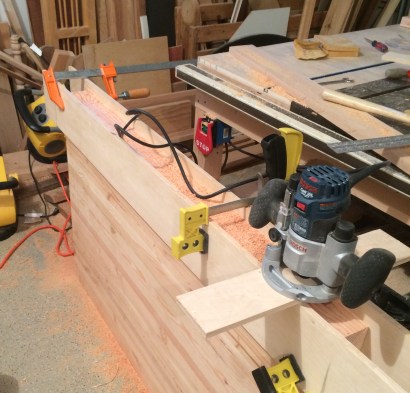
The first task I had after laminating my studs together was getting them to resemble anything like a rectangle. This was my first big project and I might have gotten in an argument with the planer over what a straight board should look like. Hence the router bride to square up the sides. This took a while to say the least. First making a jig for the router, getting straight boards clamped in the right place, but I was worth it in the end to have a square slab to work with.
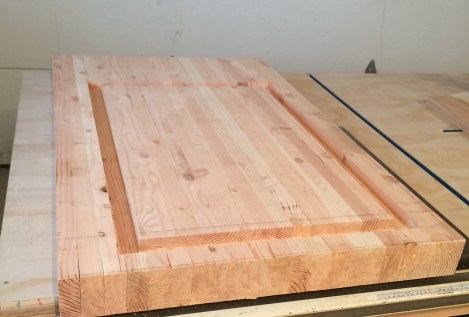
Notice the far end has more space than the near end from the edge. This is to allow for a vice to be mounted at that end. The vice on the long side I cut out holes through the base so it could be mounted. I don’t have any pictures of me assembling the base, it was a 2×6 frame top and bottom attached to notched 4×4 posts with lag screws.
Flattening the Top
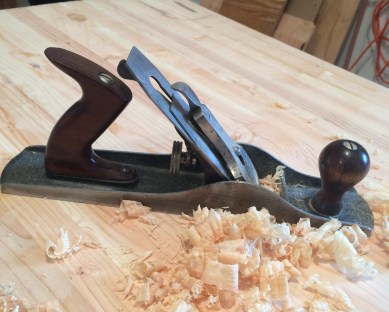
About the time I got the bench assembled my first hand plane I bought on eBay arrived. This little beauty is a Sargent 414 Jack Plane, equivalent to a Stanley no. 5. It came sharp and tuned enough out of the box that I ran to the garage and used it to smooth the top of my workbench. Forget the weights at the gym, this upper body workout is much more enjoyable and easy to do in the comfort of your garage ;0)

After smoothing the 2×4 top, I used a biscuit joiner to laminate my 3/4″ oak to fit the top. Once that was attached I added the side where you see the vice, it was a piece of 8/4 oak I happened to have in the shop. Mounting a vice for the first time is an adventure everyone should have on their own. I ended up with the smaller heavy duty quick release front vice from Rockler.
Finishing Touches
I spent a couple of months taking a cabinet making class at the local community college where I built the tool chest that fits inside the legs of the bench. Now I have a bigger garage, I’m wishing for a bigger workbench, but this one isn’t bad for starters.
After I moved garages, I finally got around to installing the planing stops along the back and left sides. There is a full length t-slot groove that the stop can move along.

I use them a lot to hold my workpiece in the corner when using a hand held router and of course planes. There was a bit of a whoops!! the first time I tried using a no. 6 fore plane with the planing stop, it tore out the t-track so I need to replace the board at the end with something thicker I can put a deeper slot into :0/
Get busy and build your own work bench so you can start using all those awesome old fashioned hand tools with ease! It’s a bit of a right of passage if you’re serious about working with wood. The things nobody tells you when you want to try something harder…….sell all your “homeowner” tools and start over with the “real” stuff ;0). But that is a story for another day.

 Girl with a Hand Plane
1 thought on “Small Workbench”